
Agentic research, recursive self-improvement, and the limits of automation
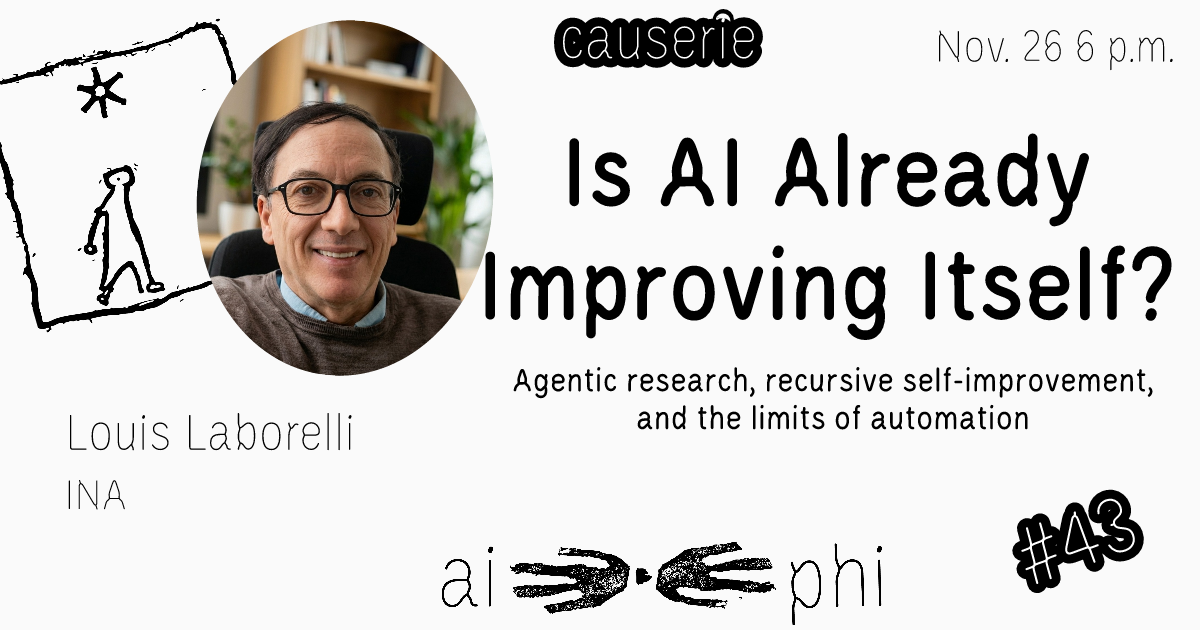
For our first Causerie of ai-phi 4.0, Louis Laborelli (INA) will open a discussion on what it would take to say that AI is improving itself. In the tradition of the Parisian intellectual salon, everyone is invited to bring questions and contribute to the conversation. The discussion will be unrecorded.
Abstract
This Causerie offers a clear-eyed, structured overview of current developments around agentic systems and Recursive Self-Improvement (RSI). We begin by clarifying core terminology—from agentic loops and task horizons to feedback effects, verifiability, and the “jagged frontier”—to separate measurable AI-assisted R&D acceleration from hype around unguided, full autonomy.
We then examine claims from frontier AI labs, including OpenAI and Anthropic, regarding heavy internal use of coding agents and faster research workflows. In contrast, we analyze METR’s evaluations and economic framing, which point to real but bounded acceleration amid measurement caveats, verification limits, and compute or data bottlenecks.
Alongside Andrej Karpathy’s autoresearch five-minute single-GPU experimentation loop, we walk through a concrete ML optimization case study—accelerating an ML algorithm in Rust/PTX—to illustrate how agents iterate on kernels, memory layout, and numerical equivalence under strict verification. We highlight both where automated tuning shines and where practical limits like local optima, hardware constraints, and scale transfer arise. Finally, we open a discussion on better progress metrics, key bottlenecks, and safety and governance implications as research loops grow faster.
About the speaker
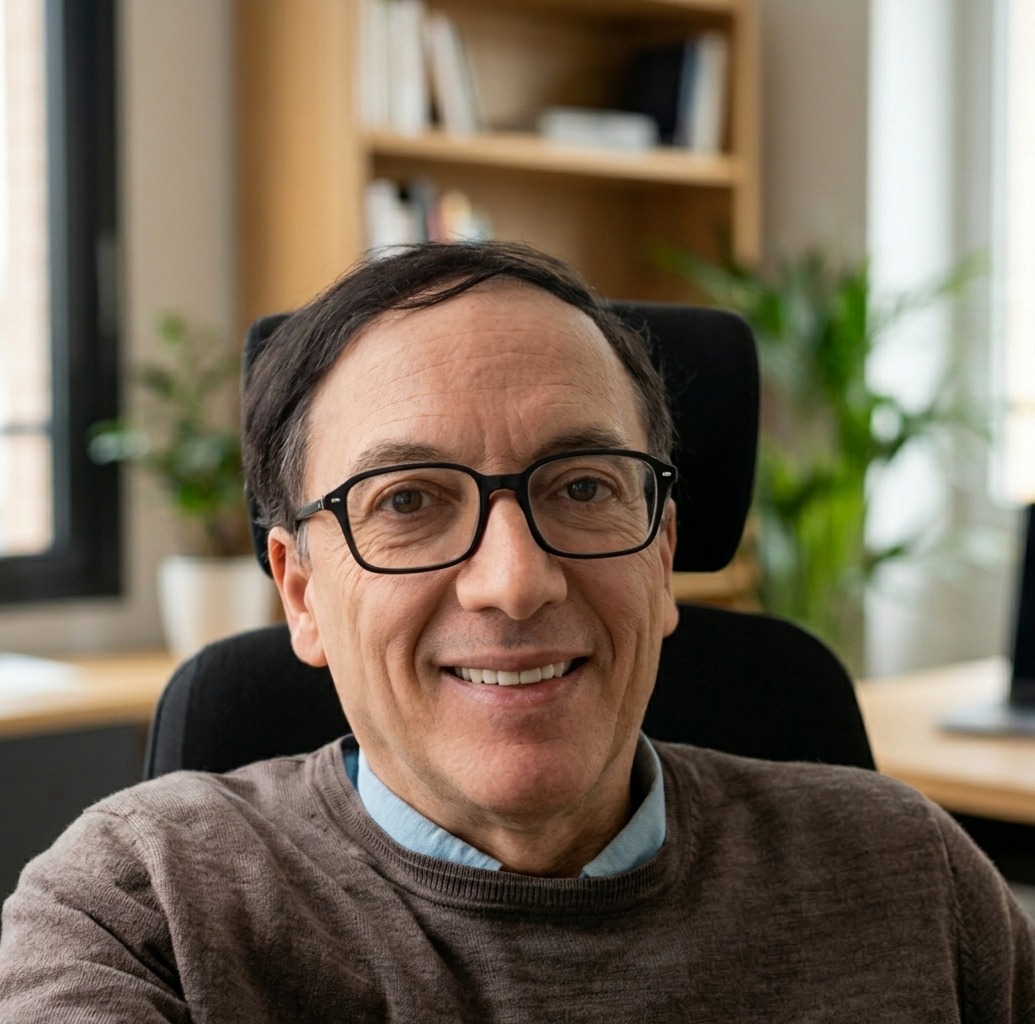
Louis Laborelli is a French researcher and engineer specializing in signal, image, and video processing, best known for his long-standing career at the French National Audiovisual Institute (INA) in Bry-sur-Marne.
Having joined INA’s research department in 1992, he initially worked on computer-assisted animation before focusing on the digital preservation and restoration of audiovisual heritage. He is notably the inventor of a patented contactless optical scanning system (the Saphir process) designed to digitize fragile, damaged, or delaminated analog vinyl and shellac records without physical wear. More recently, his research and international publications have centered on automated defect detection in digitized cinema, SECAM video quality enhancement, and the application of generative AI to film restoration and production.
Registration & Practical details
Thursday 26 November 2026 at 18:00 (Paris time, CET)
Sony CSL Paris, 6 rue Amyot, 75005 Paris
Many thanks to Sony CSL Paris for hosting us.
What is a Causerie?
A traditional seminar typically showcases a single expert’s perspective, often leaving the audience in the background, in a passive role. In contrast, we wanted to create a space where individuals could actively contribute, bringing their unique research contexts and personalities into an open-form, relaxed discussion. To achieve this, we took inspiration from the French concept of a causerie—a term originating from the Parisian salons, where intellectuals engaged in informal yet thought-provoking discussion.