
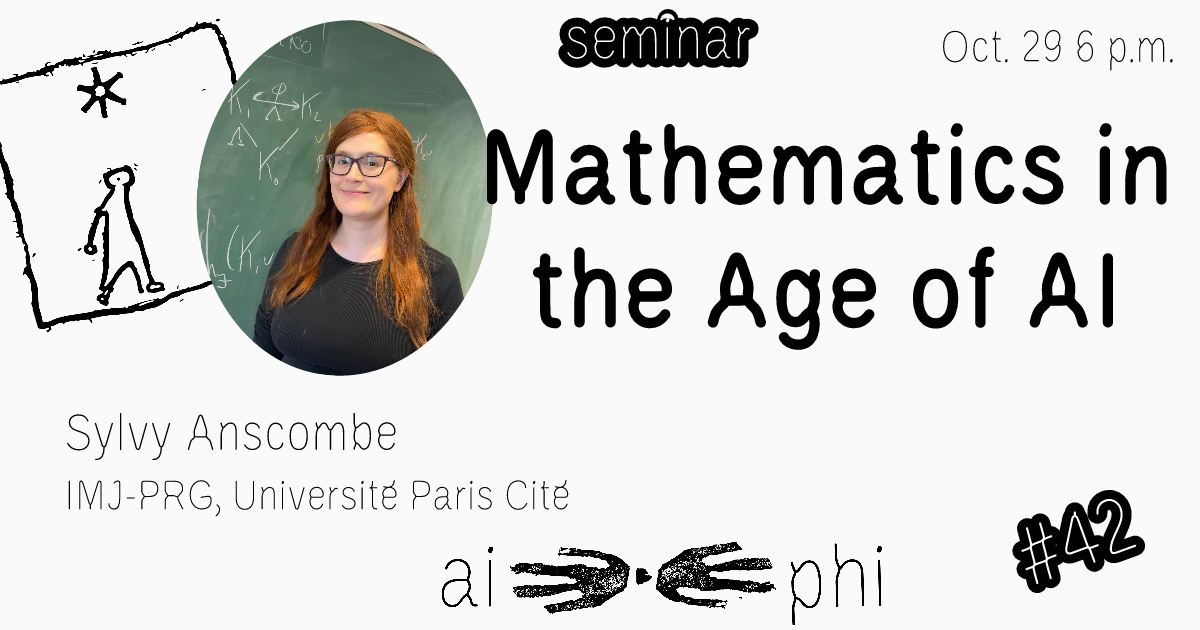
How is AI changing the way we do science and produce knowledge? Science+AI: a new Wonderland? explores how AI is transforming research across disciplines, from the questions we ask and the methods we use to what counts as evidence, explanation and understanding. Together, we will examine the possibilities these tools open up and the choices they pose for scientific practice.
We begin with mathematics: for the first session of this new cycle, we welcome Sylvy Anscombe, mathematician at IMJ-PRG, Université Paris Cité, to discuss what AI means for mathematical practice and understanding. Her talk will be followed by a panel discussion with Najib Idrissi (Université Paris Cité, Institut Universitaire de France) and Silvain Rideau-Kikuchi (CNRS, Département de mathématiques et applications, École normale supérieure – PSL).
Discussion moderated by Aïda Elamrani.
Abstract
“Begin at the beginning,” the King tells the White Rabbit, “and go on till you come to the end: then stop.”
AI systems now do mathematics: quickly, forcefully, sometimes brilliantly, and sometimes still very stupidly. By the standards we have long set ourselves, with prizes for solving the great problems, this must count as progress of a sort.
Yet the same tools may change mathematics beyond recognition. Is this the end of the beginning, or the beginning of the end? And can we, or should we, stop?
I will speak as a working mathematician who is torn. I am wary of revolutions and of a discipline shaped by large private companies, and worried about ecological cost, unequal access, attribution, and results arriving faster than human understanding. But I cannot simply dismiss a tool of real scientific value. I will argue that the answer depends less on the machines than on what we decide mathematics is for, and what it is about. The ethical questions depend heavily on the task, and AI use should be disclosed.
Above all, the heart of mathematics, thinking and explaining together, is ours to keep unless we give it up.
About the speakers
Sylvy Anscombe
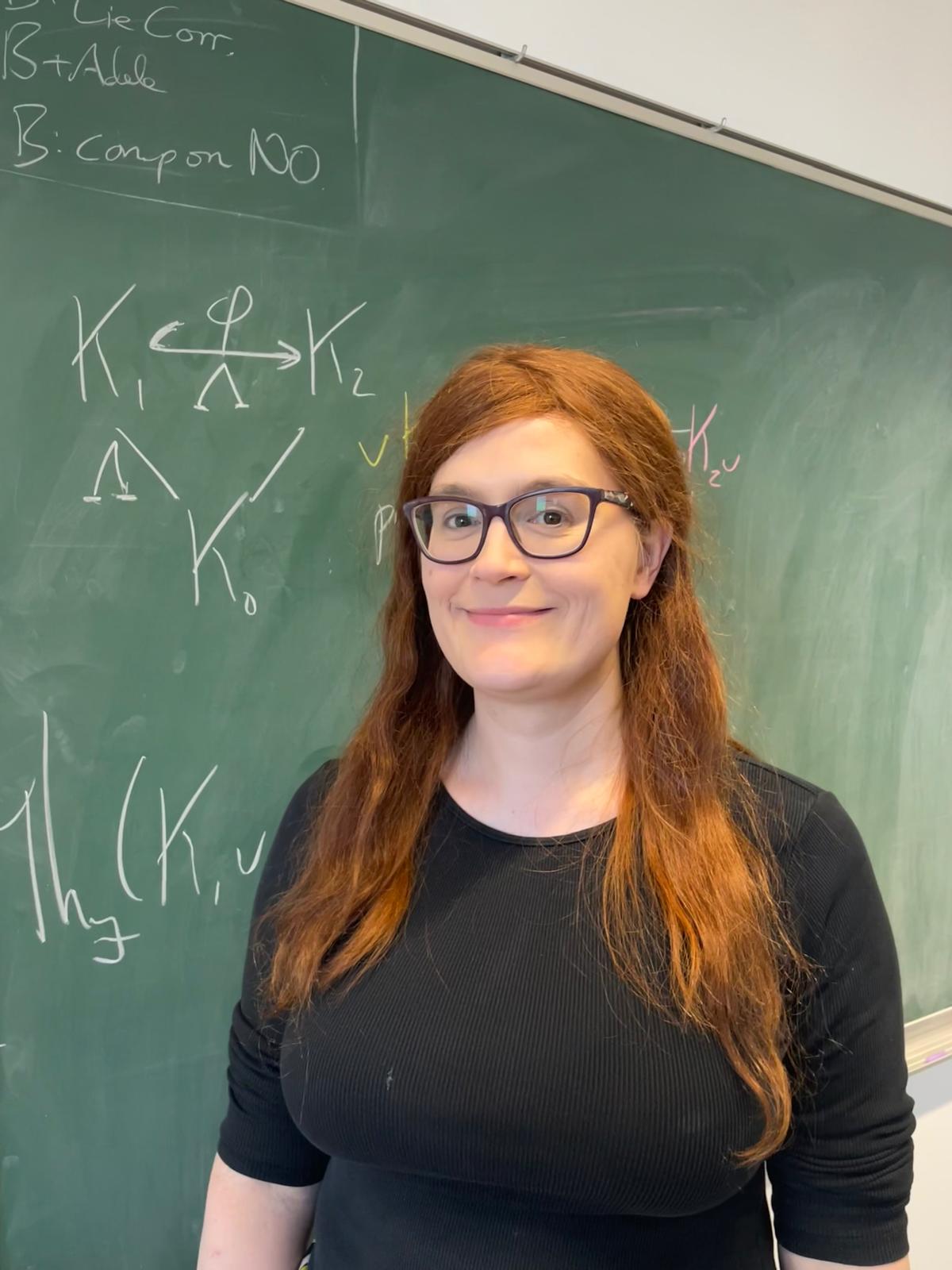
Sylvy Anscombe is a mathematician specializing in logic and model theory, and in their interactions with algebra and number theory. Heir to the very questions Gödel raised in the 1930s, model theory studies what axioms say — and leave unsaid — about the objects they describe: numbers, fields, groups.
After a childhood in the English countryside, she settled in Oxford, where she studied from her first degree through to her doctorate. After positions at the University of Leeds and the University of Central Lancashire, she has been an associate professor (maîtresse de conférences) at the IMJ-PRG, Université Paris Cité, since 2020, where she teaches and pursues her research. There she co-directs the Master 2 in Mathematical Logic and Foundations of Computer Science (LMFI).
Away from the blackboard, she has a deep love of music, and can often be caught humming in a wide variety of styles.
Najib Idrissi
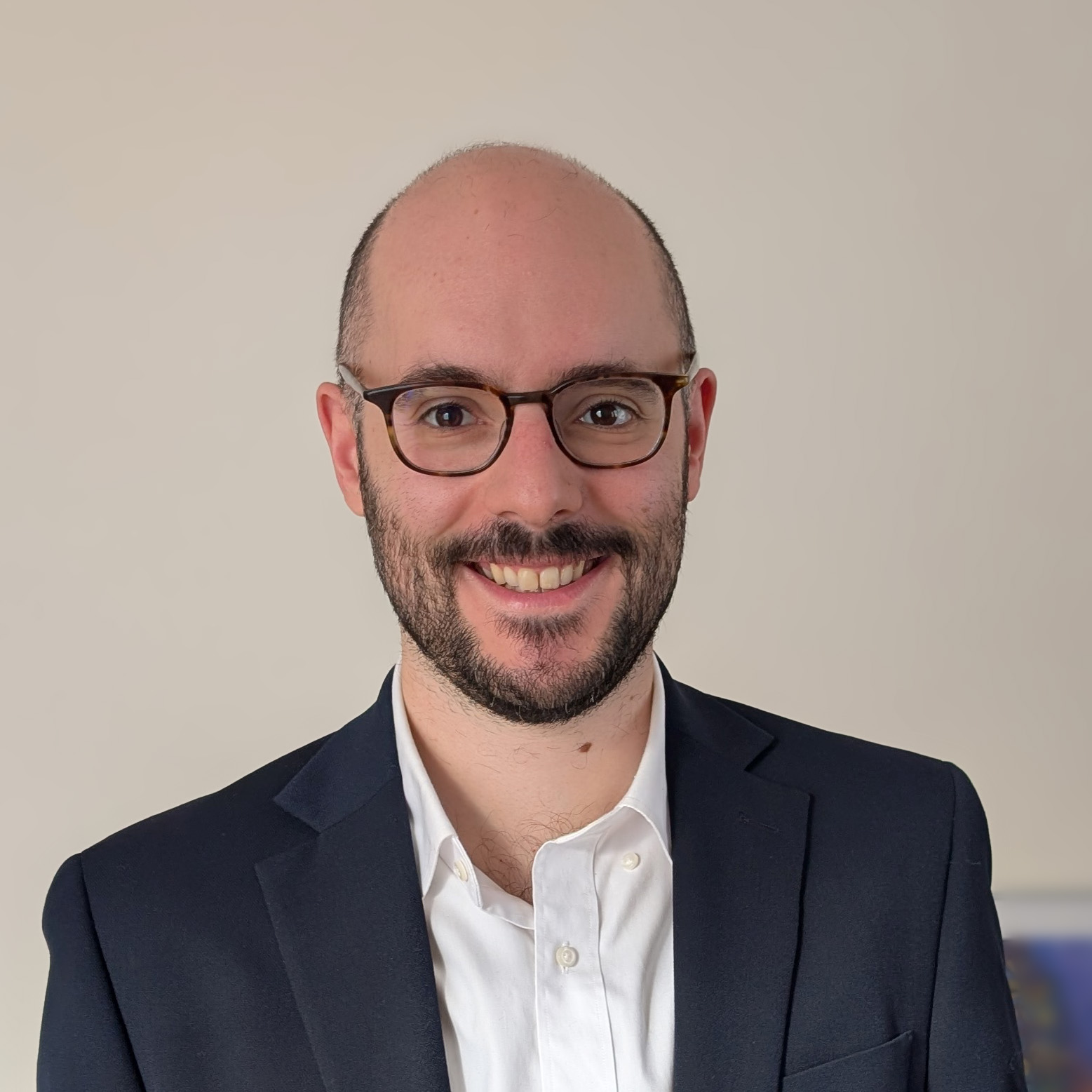
Najib Idrissi is an associate professor (maître de conférences) of mathematics at Université Paris Cité and a junior member of the Institut Universitaire de France, with a PhD from Lille (2017) and an HDR from Paris Cité (2025). His research draws on algebraic topology and higher algebra to explore configuration spaces, that is, the many different ways points can move around without bumping into each other. He also enjoys building software for mathematical research and experimenting with AI tools but keeps a critical eye on what these technologies might mean for mathematics and society.
Silvain Rideau-Kikuchi
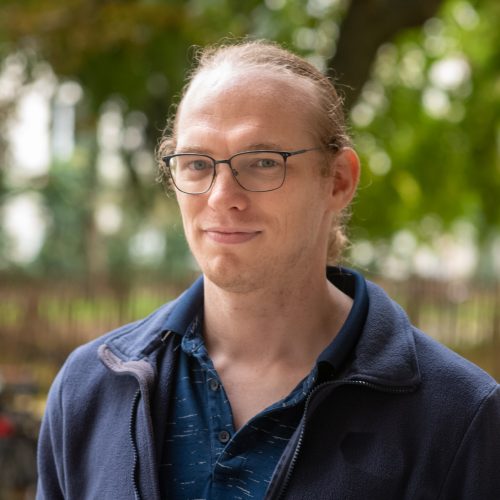
Silvain Rideau-Kikuchi is a CNRS researcher at the Department of Mathematics and Applications of the École normale supérieure in Paris. His research focuses on the model theory of fields, particularly in connection with algebraic geometry. He is a member of the Association for Human Math.
Registration & Practical details
📅 Thursday, 29 October 2026 · 18:00–19:30 (Paris time, CET)
📍 Amphithéâtre Turing, Bâtiment Sophie Germain, Université Paris Cité
8 place Aurélie Nemours, 75013 Paris
🎙️ Session 42 · Seminar · Science+AI: a new Wonderland? #1
🇬🇧 Talk in English · In-person only (no remote attendance).
Important access information: the main entrance will be closed. Please meet us between 17:45 and 18:00 at the back entrance on rue Einstein. Exact meeting point on Google Maps. Someone will guide you inside. If nobody is there when you arrive, please wait at the entrance until our guide returns.
Nearby: Bibliothèque François Mitterrand (Métro 14, RER C) and Avenue de France (tram T3a).
Venue access information and campus map
Dinner & drinks afterwards
We’ll continue the conversation over dinner or drinks at a nearby restaurant. To help us reserve enough space, please register at least 48 hours before the session (by 27 October at 18:00, Paris time) and indicate whether you plan to join us afterwards.
If you decide later, you’re still very welcome to join, but we cannot guarantee space at the restaurant.